S10E2 - Jessica DeGroot
In this episode of 'More Than Work,' Rabiah sits down with Jessica DeGroot, president and founder of the ThirdPath Institute. Jessica shares how her organization has been advocating for work-life integration for 25 years, operating as a virtual organization long before the pandemic made remote work mainstream. She discusses the importance of creating partnerships at home and in the workplace, supporting leaders to live whole lives beyond their careers, and building communities where people can find support in balancing work with caregiving, personal passions, and other life priorities. Jessica opens up about her own struggles with balance, the concept of "code red moments," and practical strategies for avoiding chronic overwork. They explore topics including remote work culture, the importance of quiet time for reflection, and how to build meaningful connections in virtual environments. Plus, Jessica shares insights about her family, her 96-year-old mother's inspiring outlook, and the skills ThirdPath teaches to help people create sustainable, fulfilling lives.
Timestamps:
00:00 Introduction to More Than Work
00:38 Meet Jessica DeGroot: President and Founder of ThirdPath Institute
02:30 What is ThirdPath Institute?
04:36 Working Remotely for 25 Years
07:30 Who ThirdPath Serves and How
11:45 Jessica's Career Journey and Starting ThirdPath
15:58 The Importance of Partnership at Home
19:41 Balancing Work and Life as a Leader
22:18 Code Red Moments and Getting Out of Balance
26:34 Remote Work and Building Community
30:42 Tips for Teams: Creating Connection Virtually
33:28 Advice for the Overwhelmed
37:04 The Importance of Quiet Time
39:50 Mantra: It's Not Impossible, It Just Feels Impossible
40:34 Fun Five Questions
44:30 Who Inspires Jessica Right Now
45:42 How to Find ThirdPath Institute
46:30 Closing Thoughts
Note from Rabiah (host):
Jessica DeGroot and I first met via email and then for a chat to see if we were a good fit for each other’s podcast. The truth is, when I spoke with her, it was like speaking with someone I had known for years. I can only hope to reach her level of wisdom. I was fortunate enough to be a guest on the “Taking Your Third Path podcast (listen here) and am happy to share this episode with Jessica on More Than Work now.
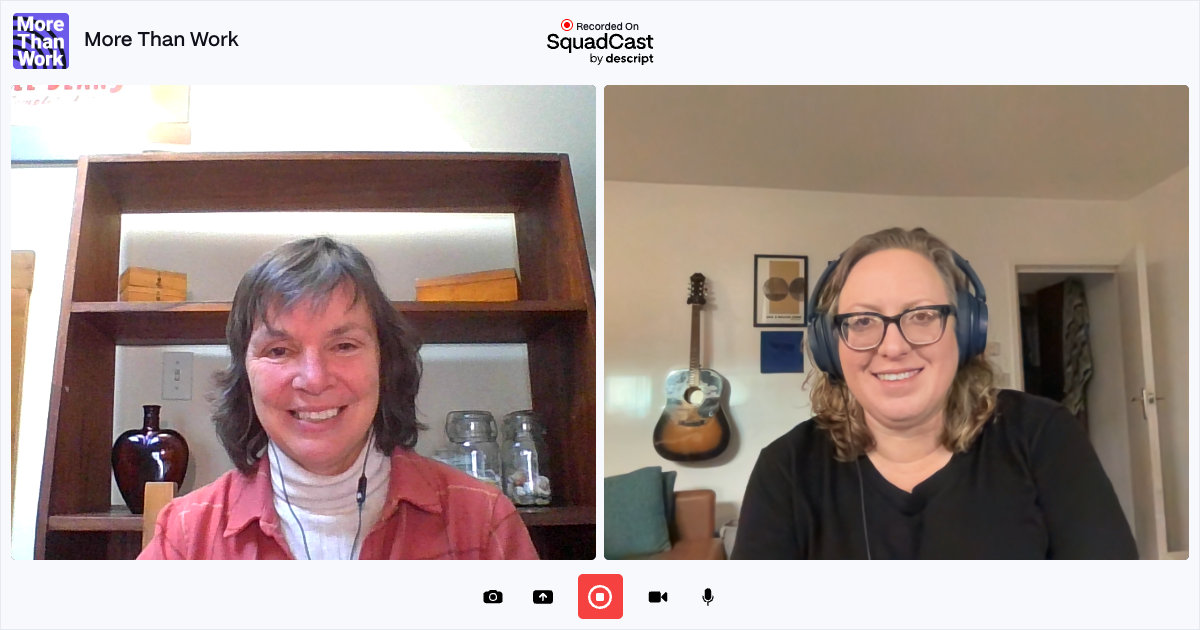
Host Rabiah (London) chats with The ThirdPath Institute Founder Jessica DeGroot (Philadelphia).
Transcript
Rabiah Coon (host): [00:00:00] This is More Than Work, the podcast reminding you that your self worth is made up of more than your job title. Each week I'll talk to a guest about how they discovered that for themselves. You'll hear about what they did, what they're doing, and who they are. I'm your host, Rabiah. I work in IT, perform standup comedy, write, volunteer, and of course, podcast.
Thank you for listening. Here we go.
Welcome back to More Than Work everybody. And this is actually the second time I'm welcoming you back because uh, I did not press record for about like the last 10 or 15 minutes. So my guest today, Jessica DeGroot, um, was also my guest about 15 minutes ago. She's the president and founder of the ThirdPath Institute.
I'm really glad to have her on partly because she's so understanding. So Jessica, thank you for being here.
Jessica DeGroot: My pleasure to be here. Thank you for [00:01:00] the doing the work that you're doing. Really. actually encouraging people to live lives, that's more than work is what ThirdPath is all about, so I'm glad to be here.
Rabiah Coon (host): Cool. Well, I'm glad to have you. So first of all, where am I talking to you from today?
Jessica DeGroot: You are talking to me from Philadelphia, but I am proud to say that ThirdPath Institute has been a virtual organization since we were founded 25 years ago. So this means that my employees are from across the country and the services we provide aren't actually, not even just nationally anymore. They are global.
We have people connecting to us from across the globe around the ideas that we're trying to promote.
Rabiah Coon (host): That's awesome. Yeah, and it's, I mean, that's one thing that's cool is people from everywhere. I can connect with people from everywhere. I mean, I'm in London talking to you over there. Um, from over there, from the US and you know, now we're, we're chatting about more than work kind of and more than work adjacent, basically subject.
So first of all, I think we'll just start with what is ThirdPath Institute?
Jessica DeGroot: We are an organization that [00:02:00] has been a long time advocate for the idea that you've been promoting, which is, work is an important part of our lives, but it shouldn't be, for most people, we don't want it to be all of our lives. We want to have time for work, and in your case, standup comedy. Um, or in my case, when I first started work and raising children, and now it's work in elder care because my life continues and different care needs, uh, emerge.
And so we've really created this community where people can find each other and learn how to put into action the ideas that you're promoting. How can I live a life that is more than work. That includes work and something else?
Rabiah Coon (host): Yeah, and that's something I definitely understand and get, and you know, part of my story is just trying to define myself by more than work and do things other than just work. I mean, I think work's important and we have to do it and we have a lot of things in our lives because someone's working, whether it's us or others.
But, um, one thing is [00:03:00] you, you said you're all over and so you guys have been working remotely for a lot longer than maybe a lot of people. I mean, I've been working remotely for nine years at the company I've been at. They were definitely ahead of the curve on that. 'cause a lot of people really only experienced that in the pandemic.
But how did you decide that that was the way to go?
Jessica DeGroot: Yeah. Well, speaking of the pandemic, you know, you're, you're so right that that was a kind of eye-opening experience for people. Um, you know, for us as an organization, it's interesting. There's so much cost savings, right? We don't actually have to pay for rent somewhere. And so as a nonprofit that's trying to change the world, that's a big benefit, you know.
And it also, like we were talking about, means we could connect with anybody anywhere. Right from the start. Um, so yes, I was located in Philadelphia, but I knew there was people across the country, across the world who were trying to figure these things out. The world of work had changed and we could do work differently, and families had changed.
Honestly, one of my favorite things about our [00:04:00] work is we really invite men into these ideas and support dads to think about this stuff differently. And we could find those dads anywhere, and they were excited to find this community of people who were. Bracing that family included men involved with care work, not just women.
Um, and so, you know, I think that we started because it made sense to us to do this way. But then I mentioned to you earlier that the ThirdPath community then was so much more prepared when the pandemic hit. Just like your organization. We already knew those, the people in the community knew that people could work remotely, they could work flexibly.
And so yes, the pandemic was hard for them, but they were so much more able to, they were more nimble in how, in the response, and more able to say, okay, let's do this. And, and so it's really just proven that this is good for us personally. This is good for our organizations. And when leaders learn how to behave this way, that it really [00:05:00] is the future of work.
Rabiah Coon (host): Total. Yeah, I totally agree. And it did make it just more, I mean, it definitely made people understand what we were doing. 'cause sometimes clients would struggle to understand, well you guys are remote. How is that working? Are you, how are you guys actually getting things done? And then it changed to, okay, this is what we need to do and we're gonna keep running our businesses.
And now there's kind of a swing back that's been interesting, but there's been pushback from employees and I don't blame them. What exactly does ThirdPath Institute do as far as just who, who they serve and how they serve them?
Jessica DeGroot: Oh, most importantly, we are, uh, a in a thought leadership role and, we do provide some direct services, and I'll talk about those in a second. But I think the thing that I'm most proud about is that we have been one step ahead in really promoting what the future of family and the future of work can look like, um, and the future of family.
Meaning that we really can create [00:06:00] families where there is a more of a, a shared approach. And that I'm not just talking about two parent households. It could be a shared approach where it's a single parent sharing with a grandparent, um, or, you know, whatever the solution is. It's the idea that parenting is important and tiring.
The more we can bring others into the process of parenting in a way that feels good and fair, the happier we will be as parents, and that's good for our kids when we're happy as parents. We also learned some skills in parenting that then really translate into being able to be good and caring for our aging parents.
And so that's good for society too. Um, so we've played this role of thought leadership around what families can look like, but we've also supported leaders to do things differently, and we've done that very specifically with some of the services we offer. We have groups for leaders at different points in their careers where they can find others who want to live this way and then feel supported in [00:07:00] that process of being part of a group who says, I wanna live a life that's more than work, but I wanna be a great leader too.
Um, and by the way, what we've learned over the years, again, in this thought leadership role, it's not that most work leaders, there are leaders who are total workaholics who wanna stay that way. Being an integrated leader is also challenging and I know that personally. And so what we've learned is how to help leaders keep committed to that goal of wanting to role model that they are, uh, care about work, but they also care about their lives outside of work.
And the more you can get leaders to role model that and behave that way, it just changes the whole organization, changes things for the team, changes the whole organization. So we are a thought leader. We also provide services to families and we also provide services to people who are moving ahead in their careers and want to stay committed to their lives outside of work and be successful at work.
Rabiah Coon (host): [00:08:00] Yeah, that's great. I mean, 'cause people, it's kind of coaching but in a different way. Like not coaching to be hyper productive and like
Jessica DeGroot: yeah.
Rabiah Coon (host): not have any spare time. Yeah. Which a lot of us don't need help doing that. We just do that. So what was your career before starting the ThirdPath and, and what brought you to say this is something that I wanna promote?
Jessica DeGroot: That's a wonderful question. Um, and there's lots of funny parts. I could tell you, I'll tell you two stories. One about the career side and one about the family side. I went to Wharton, got my MBA, quickly saw that the world of work was not ready for the ideas that I had. There's lots of stories I could tell you about learning that lesson.
And so I said, okay, I'm gonna start an organization because people need help right now. If I wait for the world of work to change, their kids are gonna be all grown up. So I [00:09:00] just made a wild decision to start this nonprofit and that's, I'm really proud of where we are today. I think we were, it was a bold move and I'm really impressed with what we've achieved, um, in the 25 years that we've been in existence.
And so I think that was part of it. I saw the world of work needed support to change and I wanted to not wait around for the world of work to change. The other was back, way back in college. I was curious. My father had this big career and was very successful and my mom was a stay-at-home mom. And I think that what her work was was really important too.
It meant that I came home to a household that felt kind of quiet and I could recharge and oh my goodness, we sat down to delicious meals as a family. And yes, some of those meals were a little chaotic 'cause my family's a little chaotic, but we were together and you know, there just was some rhythm to our lives that, and she was also very involved with the community, and I thought [00:10:00] all of that was important.
So both were important. My job, my father's job and my mom's job were both important. And I remember in college saying, Hmm, how can I have both those things? And I did a research project interviewing, this is back in the eighties when this group of women could afford not to work, but they chose to work.
And I tried to see what made their lives easier. And surprise, surprise, their husband's attitudes made a big, huge difference. And so I joke that that's when I went looking for my husband, Jeffrey, I knew that if I found the right person to partner with me in this journey, um, it would make a big difference.
And it sure has.
Rabiah Coon (host): Yeah. Well, no, that's great. And I think, yeah, I have friends who, I don't have kids, I have friends who have kids who work and then one who recently stopped working, but because of being able to really, but also not, [00:11:00] it also was a very hard decision because there's part of your identity tied to your job and you don't wanna be out of an industry too long and all that kind of stuff.
But it is interesting because I think watching people struggle with both parents working and, and that's generally what people have to do now. I mean, honestly, like I don't. I think it's really rare that there are people who don't have to do that to, to just live and because of the cost of living everywhere.
But like I visited a friend and saw how chaotic it was and how hard, and, and I just thought, oh gosh, no wonder you don't text me back, you know, like, this is what you're dealing with every day. And I'm like sitting here going, why don't you text me back? And, and even the one who stopped working now, she's like full-time like so busy. Right? Because there's always gonna be something to fill your time, especially with kids. And so I do think, yeah, the partnership and the idea of people being partners to their spouse. And I think it's, it's funny because over here in the [00:12:00] UK a lot of people use the word partner and they don't get married and they use the word partner, which you know, used to be just when you talked about gay couples, it was their partner. Now everyone says partner, but really everyone should want a partner. Like even if, I think even if you're straight and you wouldn't call them your partner, you do want a partner, You know? I think that's like a way to go really than just, oh, this is my husband or wife and I've, we have these roles and that's it. I don't know. I think it's kind of better thinking about you're both in it, you know, for the
Jessica DeGroot: Well, and it, just to underscore what you're saying, think about it. So Jeffrey and I, you know, both didn't know what the heck to do when our baby first child was born, right? We had no idea. Neither one of us had a clue what to do, but we were partners in trying to figure this out, you know? And we've learned so many skills over the years around how to do this well, including the fact that Jeffrey's as skilled as I am in saying, are we in balance or out of balance? And, what do we need to do to change? We are [00:13:00] in this together to find, uh, the right balance.
And, and, and yes, our household was chaotic at times. And yes, there were moments when it felt impossible. I'm not pretending this was always easy. Please. I don't ever pretend that, but we learned skills over and over again, including the most important skill, how to argue and get to a new idea. Because there's gonna be times when you dis disagree, right?
But we were, we, we've gotten really good at that. And so that just came in handy. Across the life course because along comes elder care and you have no clue what to do again, right? And so there's just gonna be constant shifts both on work and life side that you learn how to think about together and two minds are better than one.
And it's just been a great partnership.
Rabiah Coon (host): So have you in your work though, like, and when you're putting together, you know, papers about this kind of life or maybe putting together a new kind of curriculum for certain people or whatever, Have you ever gotten [00:14:00] out of balance in work and said, oh, I'm not even living this ThirdPath life, you know?
Jessica DeGroot: Oh, oh my God. Let me just tell you. Yes, a hundred percent in 25 years, probably at least once a year for those 25 years. And, um, and every time I've learned something that's really been relevant to teach to others, um. You know, like I've learned a phrase, "code red moments".
Code Red Moments, we all go through them. Work is too much. Life is too much. They're both too much. Oh my gosh. At ThirdPath, we even encourage all of our employees to talk about how their balance is, and they give them a scale. And a Code Red is a scale of five five. It's five on work. It's five on life because it happens. And so we are constantly trying to think even as a team of how to avoid that.
But it's gonna, you know, sometimes it happens and I've just, you know, there's just so many stories [00:15:00] I could tell you Rabiah, about what we've learned, what I've learned from those times, that then we've been able to translate into something we can share with the ThirdPath community. So, yes, wanna hear some of those times? I'm happy to tell you about them.
Rabiah Coon (host): Yeah, I mean we, yeah, I might wanna hear one. I mean, I think the thing is, 'cause what I've found is, and in different aspects and even like. I lately have felt like a hypocrite with this podcast because I was totally, just completely out of balance, I'd say. And we even talked, I mean, even not pressing record. I mean, today's been a kind of a crazy day for me. But, um, you know, I think that one thing I found is just, there's this thought that we have to be perfect at these things. And, and the reason we're doing these things is because we're not perfect. But there's this difficult like relationship with, oh, I'm gonna talk about this with people on my podcast meanwhile, like, I'm that meme of that dog typing when there's a fire all around me. You know? And that's what I, that's what feels like sometimes. And so, yeah. Maybe, [00:16:00] do you, what was the most recent where you're just like, oh man, I've gotta get this together again?
Jessica DeGroot: Yeah. Yeah, and, and, and please, anybody listening in today. Let's just be, give ourselves grace. Um, you know, one of the things that Rabiah and I were talking about is the difference between episodic versus chronic overwork. And so anybody listening in today, there are gonna be periods when you have episodic overwork, that's a given.
And what you wanna avoid is when you are at that place where it's just constantly a problem. And, and that's harder to change. So this is gonna, um maybe it's TMI, but like there was a two year period recently where I was feeling crushed by work and my husband was like, oh yeah, right. You're, you're really, uh, you know, doing great here, Jess.
He, he's much nicer than that, but he was getting tired of it. And what was going on was there were... and it's this leadership issue, right? There's things that you can control as a leader and things you can't control as a leader. And we were needing to make some [00:17:00] major changes in our board, which by the way, I'm so impressed with where we are today.
But it took two years to make some of those changes. They were very important to make. It was not something you could delegate to somebody else. It was something that had to be done and it had to be done in a relatively short period of time. And so it just took an enormous amount of work. Speaking of, you know what you do and don't have control of change.
In that same period, there was some staffing issues that happened. And again, my goal as a leader is to support my staff to live whole lives, to do more than work. And so if you're encouraging your team to have a whole life, they don't have control over sometimes things happening in their lives. And so we are a small, amazing team, and that means sometimes I need to step in and do things to support my team. So I was being pulled by my team to do some things and I was being pulled by my board to do some things. And luckily my husband had just [00:18:00] retired so he was able to pick up at home and we don't have kids at home anymore, so we made it through, but it was not pretty.
And, um, we now have a handout. That's how I do things. We now have a handout about how come that happens and what can you do about it. So we live and learn.
Rabiah Coon (host): Where there's a handout, there's a way, right? Like. I have a new PDF for you. Here you go. I like it though. I mean, I'm, when I talk to a therapist or someone that goes, oh, and I'll send you a PDF, I'm like, perfect. You know, I want that PDF, like, that's great.
Jessica DeGroot: I'll tell you one tip. One tip all the way through. I have people I can talk to, speaking of therapists, I have a literally a list of five people I can call at any time in the week, I'll text them and I'll say, Hey, can we trade 10 minutes? Because when you're going through that hard time, it is really easy to give up.
It's really easy to give up. You know, whether that's the work side, that's hard, or the home side, that's hard, right?. You might [00:19:00] be really frustrated with trying to change things at home. And, um, what I've really learned is you need support around you to, to kind of stay committed, resilient around the change process.
And I think that's, um, there's a lot of things I love about ThirdPath, but our community of support is one of the things that I'm very, very proud of.
Rabiah Coon (host): yeah, yeah, for sure. One thing around all this too is just like with people working remotely or hybrid or whatever, and sometimes it is isolating to be away from that office, especially when you've been used to it.
Like is there anything that you found that helped people or like an insight that you just had that was like, oh, this is actually what I've struggled with and this is what I do about it?
Jessica DeGroot: Yeah, I have a handout for that.
Rabiah Coon (host): Of course you do. I knew you would. I knew you would.
Jessica DeGroot: Uh, well, two in two ways. You're asking as the individual who's working, um, in a hybrid way, how to help [00:20:00] that individual. And then you're asking also I, or the way I interpret it is, what can a team leader do?
Rabiah Coon (host): Yeah. True. Yeah.
Jessica DeGroot: Um, because I think there's two sides of this coin again. There's always two sides of the coin when it comes to these ideas.
What you can do personally and what your organization can do that would be supportive. So, um, I, let's, let's start with the personal and then let's make sure we talk about the team, because I think they're both connected, right? If you, if you have them both working well. It makes a big difference.
I'm thinking about, uh, a young man I know who works fully remotely. He has most of his, his career as a young person, and what I can really see is that it could have been really isolating for him to, to work that way. What I saw him do was say, okay, hmm, I need to build community. I need to do things that's gonna make me. Yes, work is a little isolating, but I need to do things to build community.
So he joined a running [00:21:00] club. He joined a soccer club. He goes to work at a cafe instead of working always from home. Um, and so he, he's, oh, he started doing a pancake breakfast on the weekends. He now has a group of friends where they take turns cooking and serving food for each other once a week. So I think that he's a great example of, you know, you need to think outside the box and put and, and put those into a rhythm that you, um, you had a, a phrase we talked about early. Respect your life outside of work.
Rabiah Coon (host): Mm-hmm.
Jessica DeGroot: You need to put some parameters to respect your life outside of work. 'cause work will take every minute, every second that you have it. And so I, I was just really impressed with this young man's approach to thinking about, I, I am working in a way where I could become isolated, but I'm going to be proactive. Now I think there's some things we could do, uh, on the team level that [00:22:00] really makes a difference too. And I wanna share those. But any thoughts about that, those will resonate with you?
Rabiah Coon (host): Yeah. Well, one thing that, Last night I had a gig and there was a group of people that were from a meetup group that were at the bar and then they went into the gig and watched it. And I thought that was cool. 'cause I hadn't seen a meetup group in a long time, like, and thought, oh yeah, people are still doing this.
And that was cool. And so it reminds me of just when you said he joined a running club and did these things, I think, yeah, people just, they're, everyone wants connection, whether they you know, and I'm not saying that's not a new thing that I'm saying. I
Jessica DeGroot: No.
Rabiah Coon (host): repeating what I've heard other people say, but I think it's true.
And so I think that Yeah, that makes sense. And also, um, you said pancakes, so I just wanted to acknowledge that. That sounds good.
Jessica DeGroot: Yeah. Pancakes, pancake breakfast. What a what? I mean, it's so simple and yes, everybody loves it, you know. What a great solution, um, makes everybody smile and, and everybody wants connection. And so what we've learned at ThirdPath, and I'm just [00:23:00] gonna, you know, be proud about what we've done at ThirdPath. We, we, the handout is a long list of things people can do in organizations and we're happy to share those handouts.
Um. That. Uh, but at ThirdPath, one of the things we do that I think is just so easy is whether I'm having a meeting one-on-one with somebody, or we're having our Monday staff meeting, we start with something to get to know each other every single time. That's gonna get remind us that we are not just workers.
So if I'm having a one-on-one meeting with someone, you know, the phrase they're so used to me saying is, okay, tell me what's new and good from work and life. Because, you know, I wanna start by hearing how things are going and sometimes I can look at their face 'cause we're on Zoom and I'll say, okay, what's eh, what's so not so great at work and life?
'cause I can tell from their face that things aren't great. But because we've normalized talking about our lives at work and our lives outside of work, and we just do that as a regular part of the process and we do [00:24:00] it as a staff um, it just means we're curious and we, you know, oh my gosh, how did that, you know, reunion with your family, go, you know, how did that, whatever?
So I think that is just a very simple thing you can start doing with your teams where you just normalize. We're whole people. We have more than work in our lives. Um, and it just brings, makes it all more human. Um, so that's one, one little tip.
Rabiah Coon (host): So we have one project manager at work. 'cause our culture changed quite a bit, I think just over time. And also we don't do the cameras most of the time. And so the last Friday of every month we're all on camera, which is cool 'cause we all connect. Um, and actually Halloween that just passed was pretty fun for that too. But we also have a question of the week, every Friday where it could be like, what's your favorite superhero? Or something more deep or your favorite childhood like toy you played with or something.
And also since our, our company has other cul, like a lot of cultures in it, like it's people from the US, [00:25:00] people from Europe, sometimes on the call. People from Argentina. Um, we end up with a bunch of different kind of cultural exchange ideas too like, oh, we didn't have that. We had this and we learned quite a bit there, especially around food food's, a connector. But yeah, I think it's really good to connect people in that way for sure and just have a real humanness to work, right?
Jessica DeGroot: Yeah.
Rabiah Coon (host): Jessica, all this has been great and just kind of seeing how, I mean, you were really forward thinking too, uh, about this because now you have like the four day work week some places, and you have, you know, people doing like digital nomad work from anywhere, all these kind of things.
Um, what if someone right now is just going, yeah, guys, all this sounds great and I'm totally overwhelmed and I don't know what to do and you're just talking about this. What do you like? Is there something you would say or even like, something they could seek out at ThirdPath?
Jessica DeGroot: Yeah, yeah, absolutely. In fact, um, this, this, what I'm gonna about to tell you about is something we've figured out, I think even 15, [00:26:00] 10 years ago. Because we know that when people join ThirdPath that and join the ThirdPath community, some are coming because they're already really quite good at some of these things and they just wanna find fellow, you know, people who understand their, their what they're.
What they're passionate about and how they wanna live their lives. But others are joining because they're like coming up for air at a moment in time when it feels impossible. Now, that could be someone early in their career, but I've also met somebody late in their career who is like, oh my gosh, I've been living this way for so long and I don't want to do it one more day.
Well, we have something called an OMG (Overwhelm Mitigation Group) that they can join, and it's really positive for a bunch of different reasons. We've very intentionally designed it where you'll be in a group of people virtually, so it can be from anywhere. And because you're meeting other people, you don't feel alone.
You're like, oh, you are going through this [00:27:00] too? Phew. I don't feel so bad. And then we teach them some of those basic concepts I was telling you about. These are skills. These are things people can so much learn. I'll tell you about one of 'em in a second that it's gonna feel like a stretch for some people, but it's a really important skill.
And they get on this group once a month and it lets them sometime be the expert on the topic that we're teaching and they'll, they'll say, oh, I've wrestled with that. I've learned how to turn off work on vacation. Let me tell you what I learned how to do. 'cause that's one of the things we teach people is how to turn off work on vacation.
Um, and others times they'll be like, oh wow, I'm really struggling with this. But because it meets for once a month, for a year, what it does is it lets people keep on trying, failing, trying, failing until they get to a place where they're feeling a little bit more successful. And then we have some ways to support them after that too.
Um, so it's a really good first approach for someone who's struggling and we're very proud of our success with [00:28:00] helping people at that stage. I wanna give you an example of a skill we teach that's gonna feel really impossible for some people but so critical, and maybe it's one that you've had some success with.
We call it creating quiet time. In a chronic overwork workplace, back to that concept, people have very little time to think and plan and say, did that actually work? Should I do it again? You can't do that on the run. You can only do that if you actually have some time uninterrupted, maybe two hours, maybe more, where you can think, plan, assess.
And so we really teach people what's getting in the way of you creating routine quiet time? And can we help you reduce some of those barriers? Um, because by the way, if you wanna make a change in your life to get less overwhelmed, one of the things you need to do is have a little time to think.
And so, like let's say you need to start delegating something. Well, you can't just make it [00:29:00] happen. You've gotta think, who can I delegate it to? Is that person ready to take it on? What's the first step to make it happen? So quiet time is actually a really critical skill in making change. It's not an easy one. And it's one of those ones where, because you're on a call for a few months in a row, we can help each other think about how's that going. So yeah, we have some great first steps for people and I'm very proud of them and they work really well.
Rabiah Coon (host): Yeah. Awesome. Yeah, and the quiet time is important. I've been working on being more mindful and it's, it's a challenge, but I think it's, it's good. It's helpful. I mean, even sometimes I'll just have, because I usually have the radio on or whatever, music on or something, or podcast. And sometimes like I'll just ride the tube, for example, with no nothing. No noise other than what's around me. And I did a hike recently where I just didn't turn on music at all. And that was very surprising to me. But, I just kind of was like, no, I'm gonna be here. You know, and it's, it's helpful, [00:30:00] you know? Yeah.
Jessica DeGroot: Hiking in nature quietly. Oh my goodness. So powerful.
Rabiah Coon (host): Yeah, it's really great. Um, so one thing I like to ask people is, do you have any advice or mantra that you like to share with people?
I mean, you've shared a lot, but like, just anything that has kind of come to you over the past years and that you wanna share?
Jessica DeGroot: I know that what ThirdPath teaches feels a little bit impossible if you're listening in. You know, the idea that you can really create a partnership at home, um, that you can work in a workplace that supports you to live a whole life. I know that that can feel impossible. And I guess my mantra is, yes, it can feel impossible, but you really can make a, a next step towards change.
And that there really is a community of people right here, right now who will help you do that. And you know, it feels impossible, but oh my goodness, when you [00:31:00] take those next steps towards change, it is so rewarding. And yeah, there's gonna be a moment when it goes back to impossible, but you're more clear about what is possible and you're more able to stay on track with what you really want.
So, um, it's not impossible. It just feels impossible.
Rabiah Coon (host): Yeah. And that applies to so much too, so great. Um, all right.
Rabiah Coon (host): So next I have, uh, the fun five. It's five questions that I came up with that I think are fun that I like to get the answers to. So, uh, we'll get into those. So the first one is, what's the oldest T-shirt you have and still wear?
Jessica DeGroot: Yeah, I love your questions because this one was easy. I have this very thin light cotton black T-shirt that I like to sleep in. And it is not always easy to find that just right shirt. So yeah, it might have a couple of holes in it, but it is my favorite shirt to sleep in.
Rabiah Coon (host): That's funny 'cause I [00:32:00] was thinking about like this t-shirt. I'm wearing a black T-shirt and I was just thinking, oh, I need to buy five of these. Because they're like, so I get it. I get it. So if every day was really Groundhog's Day, like it felt like for a while, and sometimes it still feels like, um, and you had the same song playing on your radio every morning to wake you up, what song would you have play?
Jessica DeGroot: I had a funny thought about that one. Honestly, Rabiah, I could not do it. I would rather sleep in and miss my meeting than have to listen to the same song every day. That's just the truth. Sorry.
Rabiah Coon (host): Well, no, that's all right. I mean, Bill Murray, it drove him crazy, you know? So. All right, that's fine. Um, so let's see what you would get outta bed for though. Coffee or tea or neither?
Jessica DeGroot: For sure. Coffee. Oh my gosh. I mean, just that visual of the coffee cup and it's warm and you know, I've got a little milk in it and we like strong coffee in our household. Ah. It [00:33:00] is a great way to start the day that I get out of bed for.
Rabiah Coon (host): Alright, there you go. Um, okay. Can you think of a time that you like laughed hard and you cried, or just something that always gets you and maybe, you know, for you it might be something with your kids, but like, just something that always makes you laugh?
Jessica DeGroot: Yeah, you and I were talking about this when we first met because honestly, it's, I had to think about it and my go-to laugh out loud is I'm on that five hour car ride that I go when I go visit my mom, and it's that last hour and I'm exhausted and I don't wanna do it anymore. And I put on some standup comedy to listen to and it really is, oh my God, it just makes that last hour possible.
I just, you know, good standup comedy is just really delightful, so I'm glad you're out there doing what you're doing.
Rabiah Coon (host): Oh, thank you. Yeah. Yeah. 'cause we talked about like Nate Bargatze and stuff,
Jessica DeGroot: Mm-hmm. Yep.
Rabiah Coon (host): Um, all right, cool. Okay, so my last question is, who inspires you right now?
Jessica DeGroot: Hmm. There's a lot of people I could list here, but today I am gonna [00:34:00] list my 96-year-old mom.
Rabiah Coon (host): Mm.
Jessica DeGroot: I just spent 10 days with her helping her with some health issues and you know what she does is her commitment at 96 to making the best day possible, the best week possible, the best month possible. I mean, goodness gracious. It's really impressive to be 96 and just say, okay, I'm gonna make this work. And so she's really impressed me.
Rabiah Coon (host): Oh, amazing. That's awesome. Yeah, it's good you were able to spend that much time with her too.
Jessica DeGroot: Well, you know, flexible job. More than work. Put it all into action.
Rabiah Coon (host): Yeah, that's true. There you go. you go. Right from the right from our mouths, basically. Cool. Um, so just if someone wants to find you or find ThirdPath Institute, where should they go?
Jessica DeGroot: Well, we have a great website full of tons of free information. We're a nonprofit, so our goal is to give you free resources. In fact, we have lots of handouts that you can download from our, we have, you know, recordings of our podcasts that [00:35:00] you can listen to on our website. So that's a great resource to go to.
Third Path dot org (ThirdPath.org). We also are on all the different socials. We're, um, you know, Facebook, LinkedIn, Instagram. So follow us. We have, uh, some amazing little videos we send out to inspire you about what's going on around work and life. To just keep it, keep it all possible.
Rabiah Coon (host): Awesome. Yeah, and it's great that it's a nonprofit, so it's, you're not trying to say, get our membership or whatever, but just here, go forth, you
Jessica DeGroot: we're here. Join us. Yeah.
Rabiah Coon (host): Well, Jessica, thank you so much for being on More Than Work. Really appreciate it.
Jessica DeGroot: it It's been delightful. Keep on doing what you're doing too. Thanks.
Rabiah Coon (host): Thanks.
Thanks for listening. You can learn more about the guest and what was talked about in the show notes. Joe Maffia created the music you're listening to. You can find him on Spotify at Joe M-A-F-F-I-A. Rob Metke does all the design for which I'm so grateful. You can find him online by searching Rob, M-E-T-K-E.
Please [00:36:00] leave a review if you like the show and get in touch if you have feedback or guest ideas. The pod is on all the social channels at at More Than Work Pod (@MoreThanWorkPod) or at Rabiah Comedy (@RabiahComedy) on TikTok. While being kind to others, don't forget to be kind to yourself.